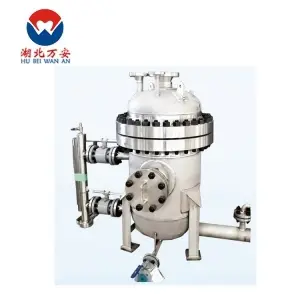
Hubei Wan'an Environmental Protection - Ball Tank Water Cutter
Ball tank water cut-off device principle - Intelligent indication
The oil-water sensor at the inlet of the medium sends a full water indication signal, which can be known on site or DCS. The on-site operator closes the valve at inlet N1, opens the valves at the drainage and nitrogen ports, and uses the pressure of nitrogen to discharge the water in the cutting water tank out of the tank. A certain height of water seal is automatically left in the cutting water tank to ensure that a small amount of residual oil and gas in the tank will not leak. When the water level drops to the set lower position, the low level alarm buzzer prompts the operator to close the drainage valve and nitrogen valve. Then, the medium inlet valve is opened to collect new sediment water in the tank.
Principle of Ball Tank Drainage Valve - Interlock Automatic Control
The switch of the inlet and outlet valves of the water cutter is interlocked. When either of the inlet and outlet valves is opened, a closing command is sent to the other valve to close it. The inlet of the water cutter is connected to the top of the spherical tank to ensure pressure balance and automatic drainage when the inlet valve is closed.
Add a manual spring valve to the export. The spring valve can only be opened when someone is present, and it will automatically close when personnel leave.
The status of the pneumatic control valve is fed back to the DCS, achieving known and controllable water cut-off.
Mechanical water cutting and monitoring control systems have played to their respective advantages and avoided their respective drawbacks. The goal of safe water cutting has been achieved through a perfect combination of mechanical and electrical components.
Specifications
Companies
Hubei Wan'an Environmental Protection and Petrochemical Equipment Co., Ltd.