- All Products
- Hubei Xingda Petrochemical - Ceramic Bulk Packing
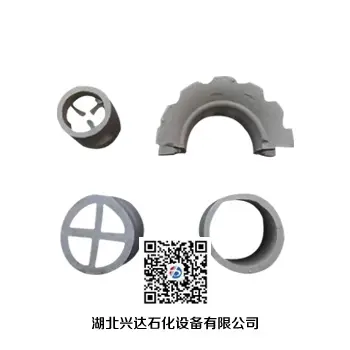
Ceramic bulk packing has excellent acid and heat resistance, can be corroded by various inorganic acids, organic acids and solvents except hydrofluoric acid (HF), and is resistant to high temperature and aging. It can be used in various high and bottom temperature occasions, with a wide range of applications.
Drying towers, absorption towers, cooling towers, detergent towers, regeneration towers, etc. that can be used in industries such as chemical engineering, metallurgy, coal gas, and oxygen deficiency.
Ceramic bulk packing materials include Rascal rings, cross partition rings, Bauer rings, stepped rings, rectangular saddle rings, cross saddle rings, etc.
1. Ceramic saddle ring
Ceramic saddle ring is a type of packing material that is processed using continuous extrusion technology. Compared with the same material of Rascal ring packing, it has the advantages of high flux, reduced pressure, and high efficiency. Compared to the Bauer ring, it has lower resistance, higher flux, higher efficiency, better packing strength and rigidity, and is currently the most widely used type of loose pile packing.
feature
The saddle ring packing bed has a large porosity, and the bed is mostly composed of circular arc-shaped liquid channels, which reduces the resistance of gas passing through the bed and also reduces the radial diffusion coefficient when the liquid flows downward. The shape of the ceramic rectangular saddle ring is between circular and saddle shaped, thus combining the advantages of both. This structure is beneficial for liquid distribution and increases gas channels. Ceramic saddle rings, due to their high density and excellent acid and heat resistance, can withstand corrosion from various inorganic acids, organic acids, and organic solvents except hydrofluoric acid
2. Ceramic Ball Ring Filler
Pall Ring packing is a type of perforated ring packing with equal height and diameter developed on the basis of Rascal rings. It has two layers of openings on the ring wall (25mm and below are one layer of openings), each layer of which has five tongue blades (plastic Pall rings connected to the center in a "well" or "meter" shape). Each tongue blade bends inward towards the center of the ring, and the positions of the upper and lower layers of windows are opposite and staggered. Generally, the opening area accounts for about 30% of the total area of the ring wall, allowing gas and liquid in the packing tower to freely pass through the openings, improving gas-liquid distribution and fully utilizing the inner surface of the ring.
3. Ceramic saddle ring
Ceramic saddle ring packing is a new type of packing that is improved on the basis of rectangular saddle ring packing. The smooth arc-shaped side of the rectangular saddle packing is changed to a serrated or textured raised side. This increases the gap between the fillers in the packing bed, making it more conducive to the flow and diffusion of gases and liquids in the packing layer. It has the characteristics of pressure reduction and high mass transfer efficiency, and is widely used in drying and absorption towers for sulfuric acid production.
4. Ceramic step ring
Ceramic stepped ring packing is a new type of high-efficiency annular perforated packing, with a height of about half the diameter. One side of the ring has a conical flange, and four high holes are evenly distributed on the ring wall. The ring is equipped with a meter shaped inner rib. The unique structural design makes the packing mainly point contact when stacked, which not only increases the porosity of the packing, reduces air flow resistance, but also greatly improves the gas-liquid distribution performance in the packing layer. This ring has one end as a 1/2 high original Raschig ring or Ball ring, and the other end as a horn mouth with a packing height of about 1/5. There are two layers of cross shaped fins in the center, with the upper and lower fins staggered at a 45 ° angle. It is suitable for carbon dioxide degassing towers and synthesis tower packing.
5. Ceramic cross ring
The cross partition ring packing is developed based on increasing the specific surface area of the packing to enhance mass transfer efficiency. Its shape is to add a cross partition in the middle of the Rascal ring. Generally speaking, this type of packing is only suitable for overall stacking due to its large size, and is currently only used as a tower bottom support distribution layer for disorderly stacking packing.
6. Ceramic Rascal Ring
Ceramic Raschig ring filler: It is a type of ceramic filler. The shape is simple, it is a circular ring of equal height and diameter. Large sized Raschig rings (over 100mm) are generally filled in a regular manner using a masonry method, while Raschig rings below 100mm are mostly filled in a disorderly stacking manner. Ceramic Raschig rings have excellent acid and heat resistance, and can withstand corrosion from various inorganic acids, organic acids, and organic solvents except hydrofluoric acid. They can be used in various high-temperature environments.
Ceramic bulk packing has excellent acid and heat resistance, can be corroded by various inorganic acids, organic acids and solvents except hydrofluoric acid (HF), and is resistant to high temperature and aging. It can be used in various high and bottom temperature occasions, with a wide range of applications.
Drying towers, absorption towers, cooling towers, detergent towers, regeneration towers, etc. that can be used in industries such as chemical engineering, metallurgy, coal gas, and oxygen deficiency.
Specifications
| Companies | Hubei Xingda Petrochemical Equipment Co., Ltd. |